Ankida Ridge Vineyards
A family-run, micro-boutique vineyard, farm and winery at 1800 feet in Virginia's Blue Ridge Mountains. Our community of wine lovers enjoys gathering to learn, travel and celebrate together.
This week, April 9-16, 2026, we are gathering on the River Seine to explore wine from Paris to Normandy, with AMA Waterways.
Learn more about Ankida Ridge Vineyards on our home page.
Seine River Cruise from Paris to Normandy
History Notes
We're pleased to share these insightful history notes prepared by our wine club member Kathryn Humphrey Chambers.
Enjoy learning about the historical events that occurred along our travel route. Cheers!
Introduction
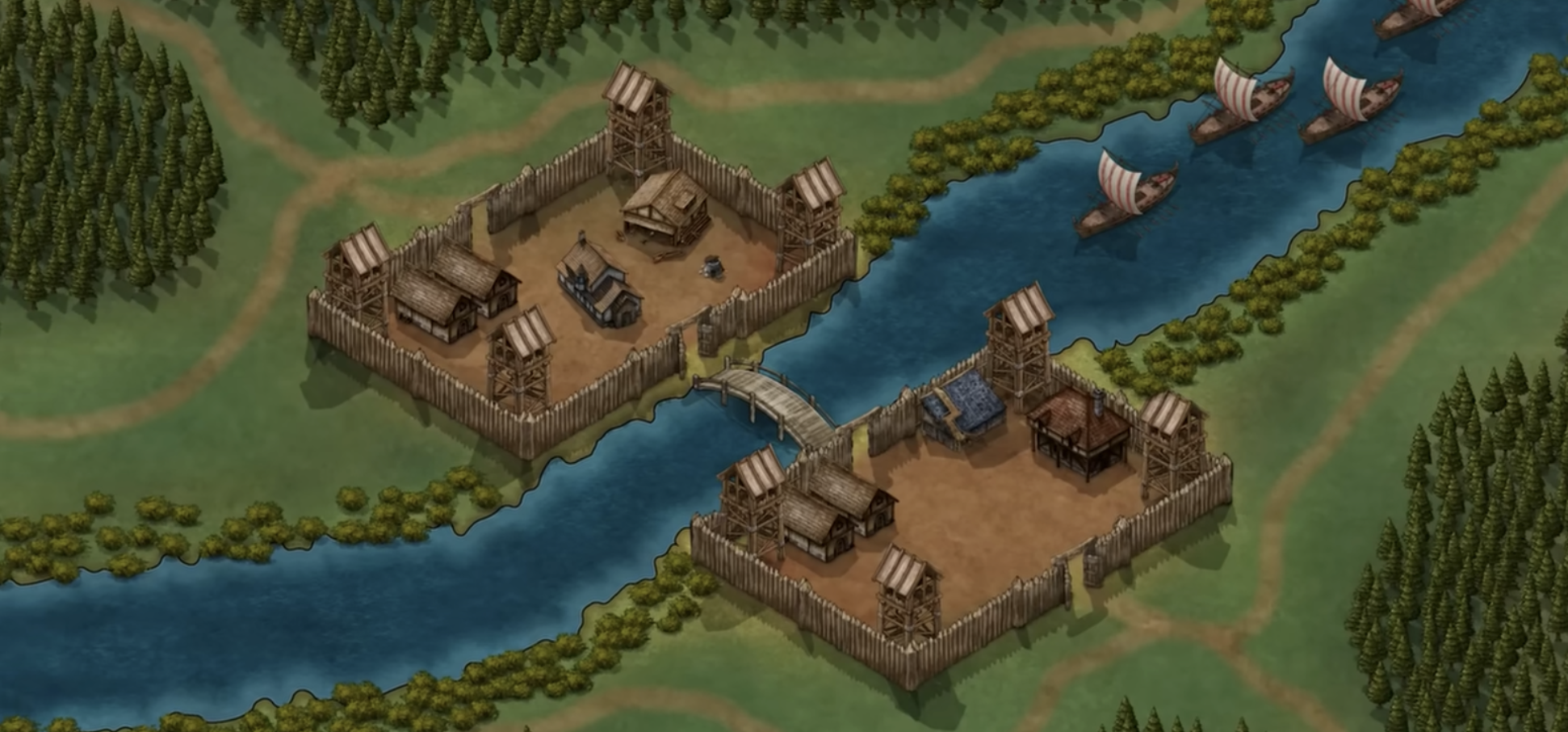
I like to imagine historic events when I’m standing where they happened. In preparation for this AMA Waterways Seine River Cruise, I brushed up on our route and what happened in the past. An idea came when our cruise literature warns that we cannot be on the upper deck when low bridges are crossed – and that got me thinking about Viking ships raiding up and down the Seine River... Building low bridges with defensive towers is how the early Francs tried to stop the Vikings coming up the Seine. In fact, even the name Normandy was derived from Land of the Norse or Northmen, and it’s interesting about how that came to be.
The examples I’ll touch are the Viking raids (845-911) and then skip to the Hundred Years’ War (1337-1453) because most of us don’t know much about it although we know some of the names and movies. The Seine witnessed the evolving relationship of Normandy to France versus England. England thought it had ownership of Normandy for reasons to be described and fought for it, and France defended it repeatedly.
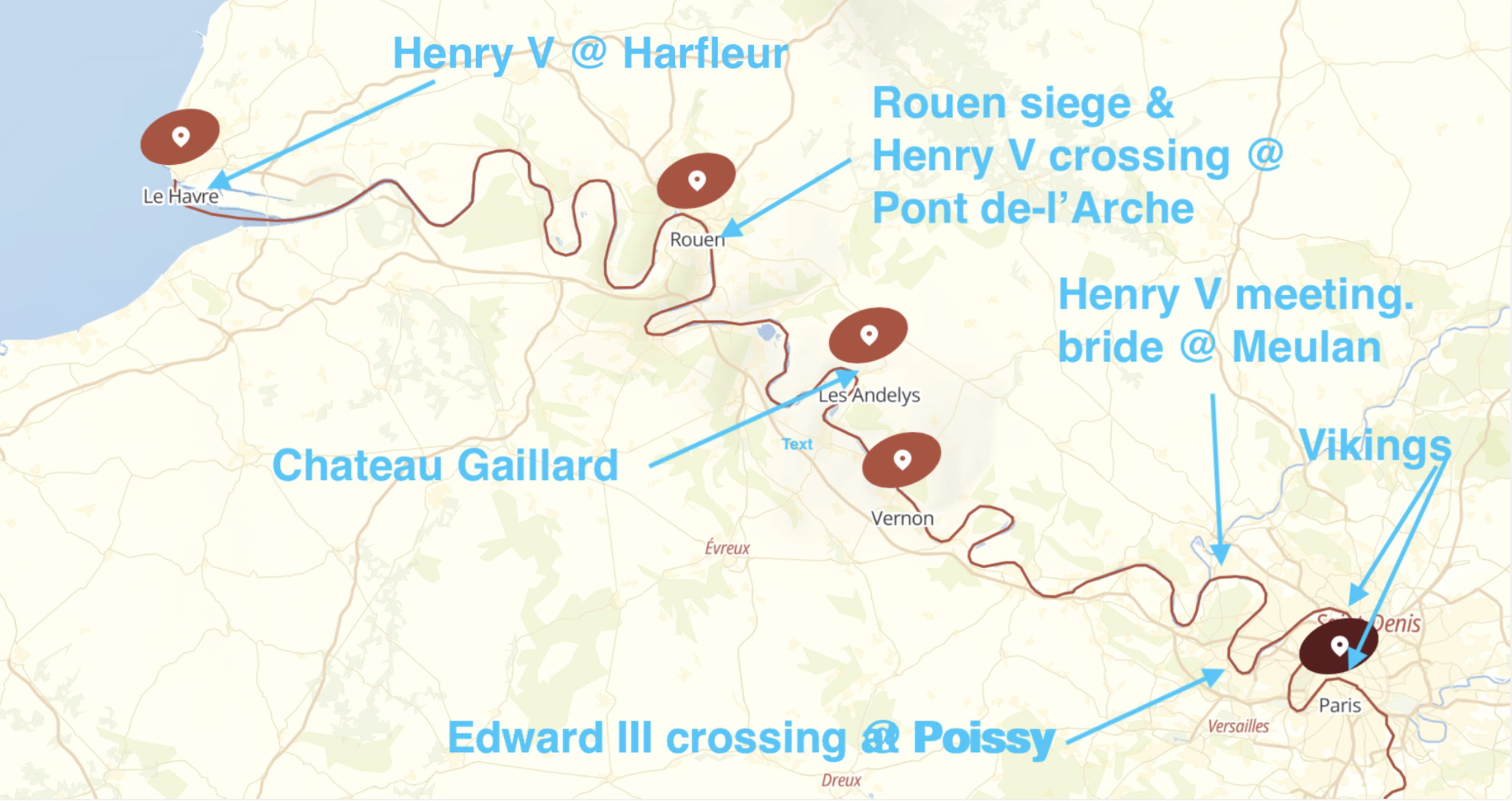
I wrote up SEVEN places to pay attention to on our journey. Each summary will have a map and some additional words, but since history is so crammed with names and dates, I’ll also include the relationship with characters most of us know and a little pop culture reference. Information was pulled from books, YouTube videos and a little ChatGPT (which was quite often incorrect).
But first, some context must be set in a whoosh. Europe used to be united, well governed and very well defended under Charlemagne the Great (reigned ever-expanding territories 768-814). His sons and grandsons were lousy rulers and eventually the Vikings raided frequently because there were easy riches to take. The route to pillage were the rivers with the shallow draft Viking ships, so the major cities of Caen, Rouen and Paris defended themselves with walls and engineered weapons to outlast a siege. Those defense walls came in quite handy for the next 600 years of warfare.
We will be going by several of the exact places where the Vikings conducted siege warfare against the Francs. During the Viking age Paris was a walled city of 5000 people existing only an island in the middle of the Seine where Notre Dame Cathedral is today, called Isle de France or often Isle de la Cite. Paris was under siege at least five times but never taken, although the final time the King of France offered a bribe if only the Vikings would stop! That Viking was Rolf (in Norse)/Rollo(in Latin)/Robert(in French) and he was offered land after 155 years of off and on raiding. The Norse took that land now called Normandy, settled nicely, and merged Viking and Franc heritage.
So why did the English think Normandy belonged to them?
Most of us know the last time England was successfully invaded was in 1066 by William the Conqueror. But did you know that William was also the Duke of Normandy? When England’s King Edward the Confessor (reigned 1042-1066) died without a male heir, William thought he was due to replace him. His claim was weak, but this was an era when territory could be taken and kept if you could defend it. The Confessor’s mother was Norman and Edward had been in exile in Normandy for several years. He got to know William as a young man and may have made certain promises. In any regard, 1066 was a monumental year.
William was the great-great-great-grandson of the Rolf/Rollo/Robert that was given Normandy by the French king if he’d pay homage as well as protect France from further Viking raids…
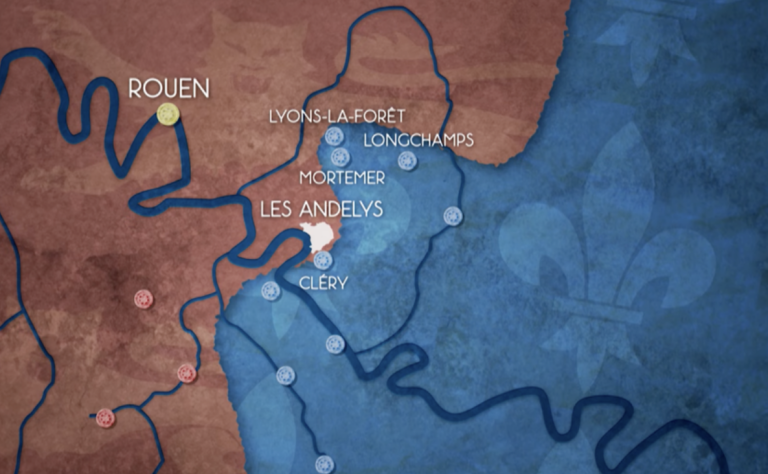
Moving forward in time, William the Conqueror’s great-great-grandson Richard I (the Lion Heart) inherited Normandy from his father as well as Aquitaine from his mother Eleanor. The Lion Heart was on crusade so long that the France’s King Philip II nibbled away at Normandy, with a little subterfuge as well. On this trip, we’re going to visit a fortress built for these battles at Les Andelys and it’s called Chateau Gaillard. Richard’s little brother King John (reigned 1199–1216) pretty much lost the rest of Normandy.
King John’s great-great-grandson Edward III (reigned 1327–1377) was also a grandson of a French king that died without a legitimate male heir. This was a terribly bad thing to do, and it’s the key fact that kicked of what’s called the Hundred Years’ Wars.
This might be a good time to throw in that the transitions of power were scary times. There was trouble if not civil war if any of the following occurred:
• No legitimate male heir.
• Only a legitimate female heir. William the Conqueror’s granddaughter Matilda was the acknowledged heir but challenged via civil war by her cousin King Stephen (reigned 1135-1154). The first queen regnant was finally Tudor Queen Mary (reigned 1553-1558).
• An underage heir and under a council of regency governed by a Lord Protector.
• If the dying king had several sons and tried to bequeath lands to each of them. William the Conqueror tried to do this, and they all fought with each other until battles, killings and imprisonments led to the youngest, Henry I (reigned 1100-1135) becoming king – but then he didn’t have a legitimate son. He had at least nine illegitimate sons.
• If the dying king had several sons but utilized primogeniture with the oldest son getting everything – that could be a problem, too. Eventually a line would run out of heirs male, and the monarchy would go up the family tree to another branch and then over and down to find an attractive candidate. If there was more than one good candidate, battles like the Cousins War (aka Wars of the Roses) would happen. As Henry VIII aged (reigned 1509-1547), he simply had all his cousins executed to protect his one male heir Edward VI (reigned 1547- 1553).
• Interestingly, it was never a problem to have lots of legitimate or illegitimate daughters. They became pawns to marry away as elements in treaties, as long as the dowries weren’t too expensive.
Returning to the Hundred Years War, it really lasted 116 years and there were several discrete battles with large armies mobilized. You might have heard of the Battles of Crecy and Agincourt which the underdog English happened to win. You probably haven’t heard of the Battle of Castillon that ended the wars because the French won. We are not going to any of these battle sites, but we will see and understand the role two Normandy beaches and River Seine played.
We will also see many sites where the French laid siege (Les Andelys) or the English (Harfleur, Caen, and Rouen). The difficulties of an army crossing the Seine casts a big shadow over history, whether you are the aggressor or defender. I picture Medieval armies as the emptying of a large football stadium with all the support staff and equipment and trudging across the countryside.
The role of castles like Gaillard and fortified cities like Harfleur surprised me, and the tragedies common people suffered in addition to the armies. Gaillard was a new design for Europe, brought back from the Crusades. Techniques for siege warfare also changed quite a bit as weapons were made more effective – again, the accompanying engineers and carpenters played a big role. As we cross under bridges on our trip, imagine an army trying to find and get across the river when bridge after bridge was destroyed – only to ask “are there any engineers with us?”
So why do I allude to kings and dukes as if they are equally powerful? Kingship in France had kept with an older governance system unlike England. This is largely simplified, but France gradually morphed towards a “king” that owned all the land, and vassals/lords/dukes that governed locally but paid homage to the king. The best perspective might be the question “do you own your house?” If you have a mortgage, it’s really the bank that owns it until you pay for in full and get the title. Similarly, the King of France owned all the land and let you live there if you served the
terms he set. Thus the French capital (Isle de la Cité) had to deal with powerful lords calling themselves Gascony, Burgundy, Normandy, Poitu, Anjou, Maine, etc.
You may have noticed earlier that I restricted the king’s gender to “he,” because France had Salic law restricting female succession. England struggled with this, too, but tried now and again to deal with queens because the cost and pain of civil wars was so great. France stuck with the program. This was the cause of the Hundred Years war, with a dose of insults between an English king (Edward III) that had inherited what was left of what his great-great-grandmother Eleanor of Aquitaine brought to the English king (Henry II) in marriage. Edward III thought he owned it outright, and the “bank” or King Philip VI of France disagreed. Addionally, many of those other regions of France hated Philip and rather encouraged England to invade.
Beginning in Paris (and passing by the same spots on return to Paris) here are some interesting locations on the river that have additional history notes:
• Île de la Cité (885-886) Rollo lays siege to the fortified city of Paris for nearly a year, then is bought off with silver by Charles the Fat and is granted what becomes called Normandy.
• Meulan-en-Yvelines (1419) Henry V met future bride Catherine of Valois, becoming heir to France. It was staged on the banks of the Seine with glorious tents and ceremony.
• Poissy (1346) Edward III finally/desperately crossed the Seine being hunted by the French, before a miraculous victory at Crécy.
• Gaillard at Les Andelys (built 1197-1198, fell 1204) King Richard I Lion Heart built it, King John lost it when the French found its only weakness.
• Pont de-l’Arche (1418) Henry V triumphantly/ingeniously crossed the Seine being defended by the French.
• Rouen (1419-1419) Henry V’s siege was deadly but successful, yet he died only three years later.
• Harfleur (1415) Henry V landed on rocky shores and took the fortified city by siege and exhausted his army, before a miraculous victory at Agincourt.
Movie buffs may think they know these histories by watching VIKINGS, THE KING, AN AGE OF KINGS, THE HOLLOW CROWN, HENRY V… Theater buffs may be familiar with Shakespeare’s historical plays KING JOHN, RICHARD II, HENRY IV Parts I&II, HENRY V, HENRY VI Parts I,II&III, RICHARD III, HENRY VIII. Dramatic license was taken with all of the above, and won’t it be great to see the actual places where these events happened!
So, shall we back up and begin in Paris with Viking ships coming up the Seine?
Vikings in Paris
The history of Vikings in France—especially in what is now northern France—is a mix of violent raids, long sieges, and eventually settlement and cultural blending. It spans roughly from the late 8th century to the early 10th century.
Where: Paris
When: 845, 885-886
Who & Relation: Mythical Ragnar, then finally Rolf/Rollo/Robert who is the great-grandfather of William the Conqueror
What: At least 5 sieges
Pop Reference: TV show VIKINGS season 3 episode 7-10
The first major Viking attack in the region came in 799 CE, when Norse raiders struck the coast of Aquitaine. But the event that truly shocked the Frankish world was the attack on monasteries and towns along major rivers like the Seine and Loire. One of the most famous early incidents was the raid on Abbey of Saint-Germain-des-Prés near Paris. Monasteries were prime targets because they were wealthy and poorly defended. Vikings used longships to sail deep inland, allowing them to strike cities that thought they were safe.
The Siege of Paris (845 CE)
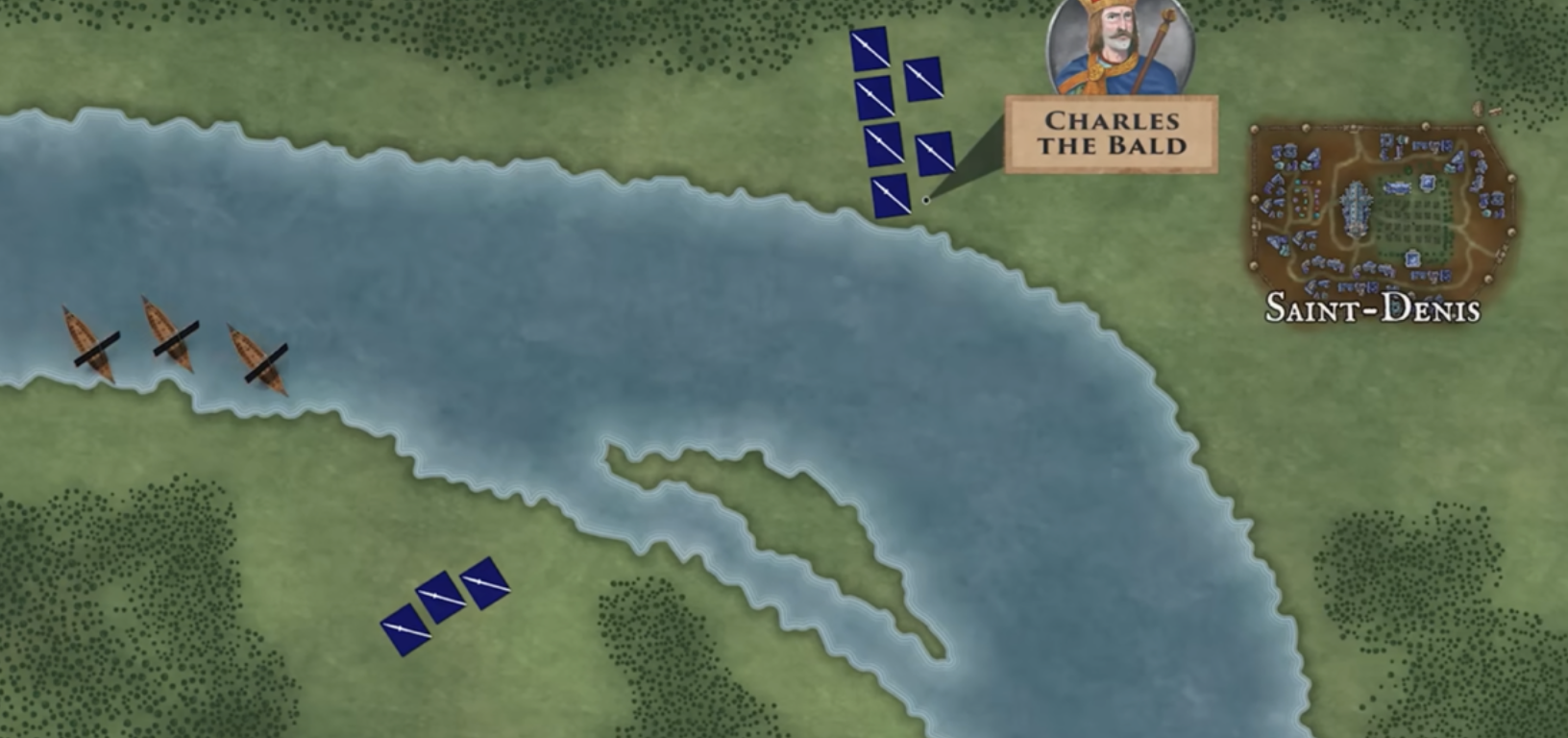
A Viking force led (according to tradition/legend) by Ragnar Lodbrok sailed up the Seine very early in the season (March) and the Franks were not prepared. The defenders stationed themselves on either side of the Seine near St. Denis, but the Vikings noticed that the army one side, or what we call today the Left Bank, was smaller. It made sense to attack that one first, and they were successful which made defeating the other proportion of the Franc army easier. They attacked and captured Paris. The Frankish king, Charles the Bald, chose to pay a large ransom (called Danegeld) to make them leave.
👉 This set a pattern: Vikings would attack, and rulers would sometimes pay them off rather than risk destruction.
Continued Raids and Settlements
Throughout the 9th century, Viking raids intensified. Towns like Rouen, Nantes, and Bordeaux were attacked repeatedly. Vikings began overwintering instead of returning to Scandinavia. Some groups started to settle permanently along rivers. The Franks struggled to defend their territory due to internal conflicts and weak central authority.
The Siege of Paris (885–886 CE)
Another major turning point was the Siege of Paris (885–886). Thousands of Vikings besieged Paris for nearly a year. The city was defended by Odo of Paris. The Vikings failed to take the city outright but devastated the surrounding region. Again, the Frankish ruler paid them to leave.
👉 This showed that while Vikings were powerful, fortified cities could resist them.
🤝 The Creation of Normandy (911 CE)
The most important long-term outcome came with the Treaty of Saint-Clair-sur-Epte. The Frankish king Charles the Simple made a deal with a Viking leader, Rolf/Rollo. Rollo was granted land around the Seine in exchange for defending the region from other Vikings, converting to Christianity and changed his name to Robert I of Normandy, and finally becoming loyal to the king.
🛡 From Vikings to Normans
Over time, the Viking settlers adopted the French language, converted to Christianity, and integrated with local culture. They became known as the Normans. One of their most famous descendants was William the Conqueror, who later led the Norman Conquest of England.
Henry V and Catherine of Valois
(the Royal Bride that changed England forever)
Where: Meulan-en-Yvelines, NW of Paris within a few hours by boat
When: Henry desired her for years, they met in 1419, and married 1420 marking nearly the end of the Hundred Years War
Who & Relation: Henry V is the great-grandson of Edward III. His father was Henry IV (Bolingbrook, the usurper of Edward III’s heir Richard II). It’s also interesting to note that after being widowed, Catherine became the grandmother of Henry VII – the first Tudor king.
What: Political negotiations set aside the French heir and promised France to Henry V, but that’s not what happened.
Pop Reference: Famously featured in Shakespeare’s Henry V, also the movie THE KING (2019).
The meeting took place at Meulan-en-Yvelines, a town on the Seine northwest of Paris, on the Right Bank. By this time, Henry V had already won major victories, including the Battle of Agincourt and much of northern France was under English control.
France was politically fractured and weakened, divided between rival factions the Armagnacs (loyal to the French crown), and the Burgundians, who at times allied with England but were really into getting anything they could for themselves. This was of course, a common theme for the era.
King Charles VI of France was mentally unstable, making governance chaotic. This instability allowed Henry V to push for not just land—but the French crown itself.
🤝 The Meeting at Meulan
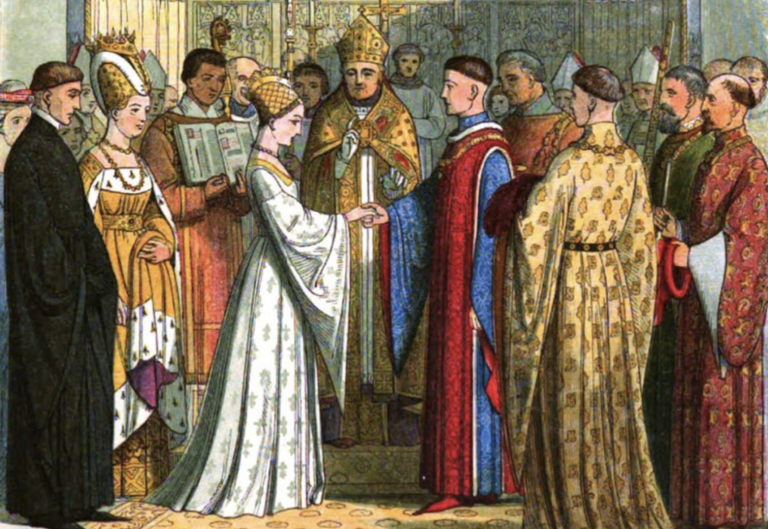
At three o’clock on the afternoon of May 30, 1419, large bands of noblemen, counselors, attendants, and guards watched from both sides. The meeting ground was in a meadow on the banks of the river Seine, close to the town of Meulan. The meadow was divided into French and English zones, each fenced off with tall wooden palisades and – on the French side – wicker screens to defend against the longbow shot. Between was a neutral zone, also ringed with more huge fences, with armed guards posted at each of its three entrances. There was a bespoke pavilion where the negotiations took placed. It was an extraordinary sight. It had taken much fraught diplomacy to arrange, and only after several battles were won.
This was not just a romantic meeting—it was part of marriage negotiations tied to a peace treaty. Included in the discussion was the marriage between Henry and Catherine, recognition of Henry as heir to the French throne and disinheriting the last son of the French king, and terms to end (or pause) the war.
💬 The Famous Courtship Story
Later tradition (popularized by William Shakespeare in HENRY V) portrays Henry courting Catherine in a charming, awkward bilingual exchange. In reality, Catherine likely had little personal choice and the “courtship” was highly political. The outcome was the Treaty of Troyes (1420).
💍 Marriage and Aftermath
• Henry and Catherine married in 1420
• Catherine became Queen of England
• Their son would become Henry VI of England, which carried on the line of Lancaster begun by Henry IV Bolingbrook the Usurper. Henry VI suffered from mental illness, and a cousin’s faction headed by Edward of York sometimes ruled as regent. The Lancaster and York sides battled – and eventually Edward of York’s son became the first York King Edward IV. Many of the themes of HBO GAME OF THRONES comes from this conflict: Lancaster versus York ~ Lannister versus Stark.
👉 However, Henry V died in 1422 before inheriting France, and the settlement eventually collapsed.
Edward III at the Beginning of the Hundred Years War: Poissy
Where: Poissy, the first bridge the English found to cross the Siene that the French hadn’t completely destroyed and that they could rebuild
When: 1346
Who & Relation: Edward III, bad King John’s great-great-grandson
What: Two huge armies shadowing each other & the English running out of resources
Pop Reference: There’s not a lot, but Edward III featured in WORLD WITHOUT END (2012). He’s a fascinating ruler and there should be much more!
This is the early phase of the Hundred Years' War, involving Edward III of England’s claim to France. After the French King Philip VI confiscated all of lands in France, Edward maneuvered his large army across northern France while pursued by the French King. As invasions, sieges and shadowing armies are concerned, this campaigned happened very quickly.
On July 12, 1346, Edward landed unopposed on the sandy beaches Normandy at Saint-Vaast-la-Hougue. Philip had stationed the French army in Gascony/Aquitaine in SW France, so it took quite a while to reposition them and find the English. Edward launched a destructive raid (a chevauchée) across northern Normandy to spread fear of destruction and quick surrender. This worked well to some regard, but in contrast his great-grandson Henry V’s similar campaign in 1417 used an entirely different technique – ordering his English army to treat the populace as his beloved people…
Edward didn’t feel that way, instead sending the message that Philip couldn’t even protect what he called his own people. Only two weeks after landing, Edward ordered the city of Caen to surrender on July 25. They refused of course, and the next day the English took the city by force, but what followed was five days of killing, looting and predictable crimes. Inside the castle of Caen there were still defenders, and after the English moved on they retook the city and port. But for Edward, he demonstrated power . From Caen the army marched east aiming to further weaken French resources and force a decisive battle. Philip gathered a large French force and moved from Paris to intercept him, waiting to hear what had happened at Caen and what Edward’s next plans would be. Unfortunately, Philip appeared to be dithering, but on July 31 he marched into Rouen, and had ordered every bridge between Rouen and Paris destroyed.
As Edward’s army approached the Seine River, the French attempted to trap him. In military terms, a river (or wet crossing) is very challenging. By mid-August 1346, Edward reached the Seine near Rouen. The French had already destroyed or blocked bridges, guarded key crossing points, and positioned forces to cut off escape. This effectively pinned the English army against the river, with the French closing in—a dangerous situation.
Edward desperately needed to find a bridge intact. Instead of attempting a direct crossing near Rouen, Edward made the critical decision to march upriver along the Seine, desperate to find a way to cross using an undefended or repairable crossing point. Meanwhile, French forces shadowed him on the opposite bank. This was a tense race—if the French caught him before he crossed, the English army could be destroyed.
On August 12, Edward finally reached Poissy (20 miles from Paris) where a bridge had been partially destroyed but the stone pillars remained. English engineers and troops repaired it quickly. After crossing, Edward has the bridge and town burned. This was a crucial turning point which allowed Edward to escape the trap and continue north towards his allies in Flanders.
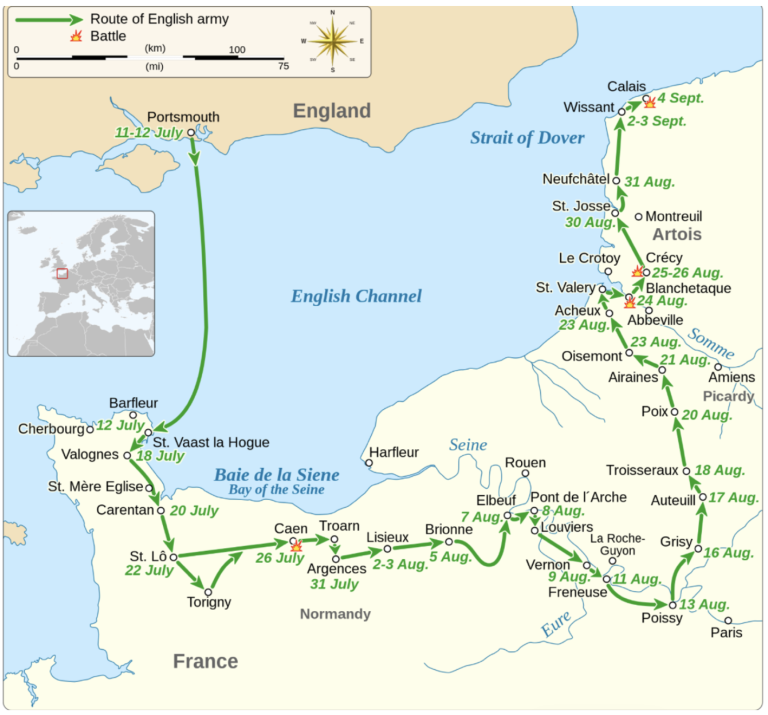
Even after crossing, Edward was still in danger. The French continued pursuit, and the English later faced another wet crossing at the Somme River. Today the Somme appears as a gentle canal, but in the day was a very wide, wet and tidal river system perhaps 2000 yards across. Some local knowledge described a possible ford at Blanchetaque, which was likely a hard, chalky river bottom walkable only at low tide. Its exact location is unknown today. With hours to spare from the pursuing French, the English army moved toward Crécy-en-Ponthieu.
Shortly after these maneuvers, the armies met at the Battle of Crécy (August 26, 1346), where Edward’s outnumbered forces won a decisive victory. They continued to Calais and laid siege (starvation not destruction) for a year before victory, then holding the Calais stronghold for the next 200 years.
Chateau Gaillard
Impregnable Fortress built by Richard I The Lion Heart
& Fell the first time it was under Siege
Where: Les Andelys and Chateau Gaillard
When: Built 1197-1198, taken by French siege 1203-1204
Who & Relation: Built by Richard I Lion Heart (reigned 1189-1199), the oldest surviving son of Henry II and the great Eleanor of Aquitaine. Henry’s mother was Matilda, the only legitimate child of Henry II (William the Conqueror’s grandson). The English nobles vowed to accept Matilda as ruling queen, and then didn’t which led to civil war.
Richard I died just one year after Gaillard was finished, (and by rumor) bypassed his rightful nephew and passed the English crown to his little brother John. John I was not good at military matters.
What: Richard had spent many years on crusade and he returned with better fortress designs. Gaillard was built extremely quickly.
Pop Reference: A great movie about the family dynamic is THE LION IN WINTER (1968) with Peter O’Toole and Katharine Hepburn. It’s not a good characterization of Richard I but John I is spot on.
This history is BEFORE the Hundred Years War. The Siege of Château Gaillard (1203–1204) was a pivotal episode in the struggle between England and France during the reigns of King John of England and Philip II of France. It marked a turning point in the collapse of English power in Normandy.
Château Gaillard was a massive fortress built by Richard the Lionheart in the late 1197-1198. Perched dramatically above the River Seine, it was designed to block French advances into Normandy, control river traffic toward Rouen, and serve as a symbol of English Plantagenet strength. Richard reportedly boasted it could withstand any siege, but he died 1199 of a wound that became gangrenous. His supposed heir and youngest brother John I, did not have the same warrior mentality.
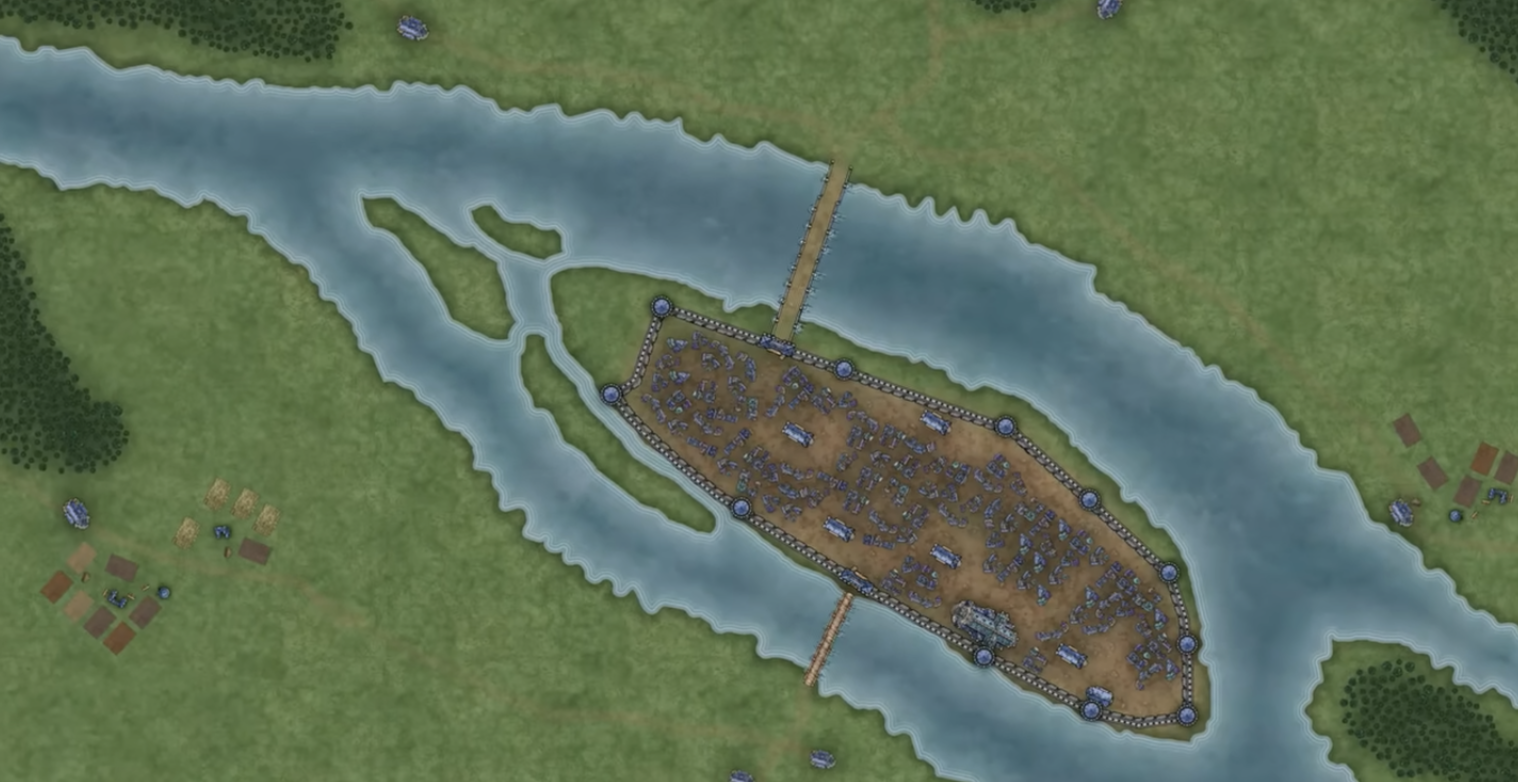
army could inhabit the homes and infrastructure for a long siege. The castle had English soldier and a large armory with enough supplies to last well over a year, but the garrison commander made the mistake of allowing 2000 villagers to enter seeking refuge. This created overcrowding and food shortages within. Further isolation were two concentric ring walls built surrounding the castle, preventing supplies and communication, and weapons were built to attack the fortress.
By the winter 1203, England’s King John I failed to mount an effective relief effort—one of the major criticisms of his rule. Hundreds of civilians trapped inside were expelled by the defenders to conserve food. Philip’s army refused to let them pass, leaving them starving between the walls and French lines. Morale inside the castle deteriorated.
The forward keep walls were undermined by burning the beams that supported the walls, and the English retreated to an inner baily.
There are two theories about getting through the second layer of protection. Either the defensive walls were negated by King John’s alteration by cutting windows into a newly built church, or perhaps the wardrobe/toilet exit was unguarded and men crawled up. When the French gained entry into the middle keep, they brought a siege engine to blast through the final walls. The English surrendered and the French accepted victory ceremoniously.
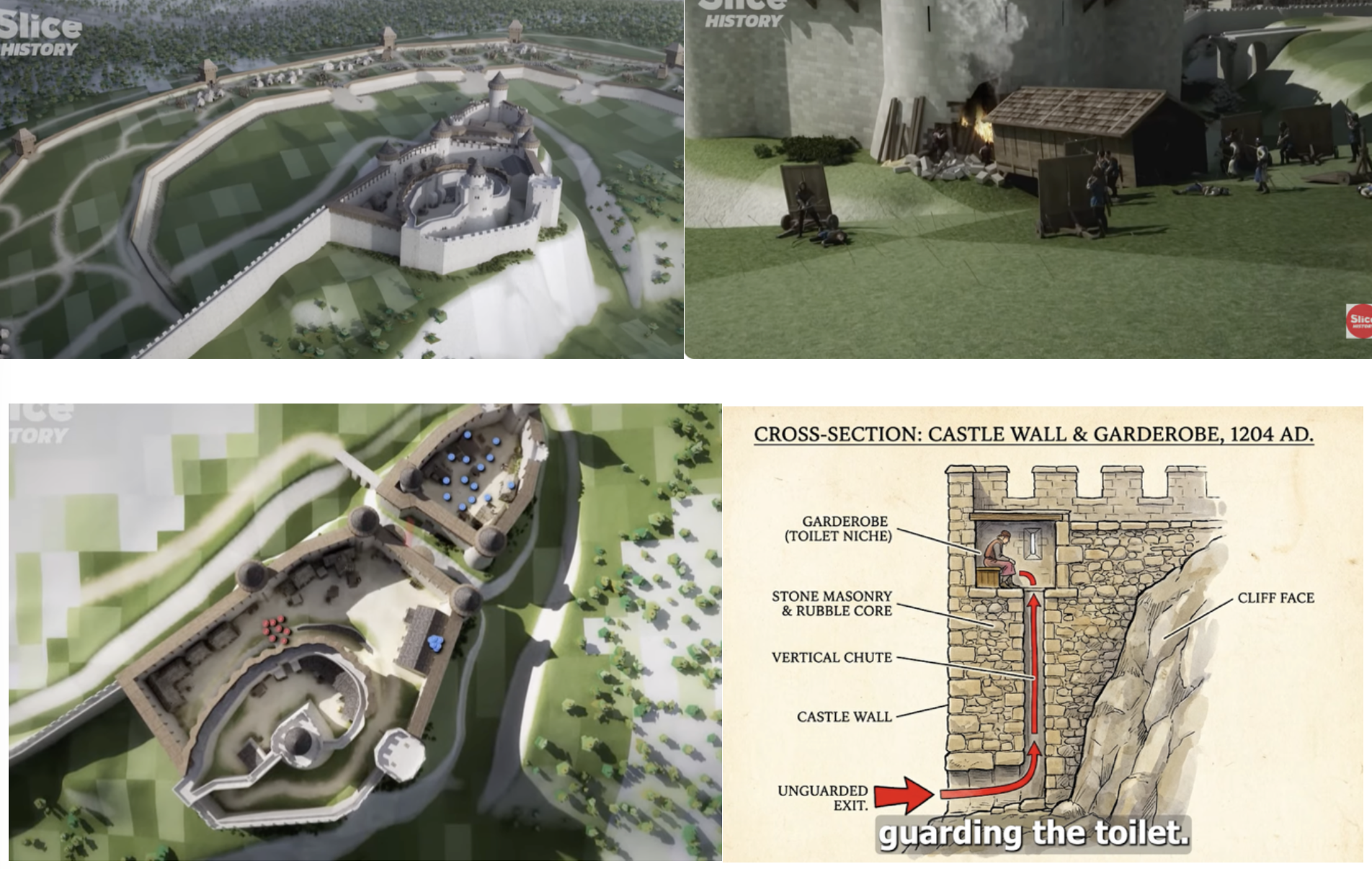
Siege of Rouen during Hundred Years War & Pont de l’Arche
Where: Rouen
When: Henry V 1415-19
Who & Relation: Henry V is the great-grandson of Edward III and victor and Agincourt.
What: A horrific siege with clever engineering on offense and defense.
Pop Reference: Just books and YouTube
Here’s a side story about the castle at Rouen. Only one tower remains, but the walls used to be along the river. In the year 1203, a murder likely happened that changed history. We’ve been taught that King John was a lousy fellow which led to the great Magna Carta and the foundations of representative government, but according to rules of the day he shouldn’t have inherited the throne. The rightful heir was the young son of Richard I Lionheart’s next younger late brother, Geoffrey. John, the youngest brother, didn’t like hearing this and took to battle, capturing young Arthur in Falaise and bringing him to Rouen. There, Arthur (age 15 or 16) simply disappeared and history suggests he was murdered and thrown in the Siene.
But back to the fourteenth century, Edward III did not capture Rouen. While he devastated Normandy and passed near the city during his 1346 campaign leading up to the Battle of Crécy, he did not take it. The city was famously captured by King Henry V, who took Rouen on January 19, 1419, after a six-month siege.
After the Battle of Agincourt in 1415, Edward’s great-grandson Henry V returned to England via Calais to celebrate victory. His army stayed behind in Harfleur. The French nibbled to reclaim territory and by 1416 the English were close to starving due to French blockade of supplies, so Henry sent an English armada to break the French and supply his army. These were the seeds of the English Navy.
Henry returned but this time landed on the west bank of the Seine at Touques. He wanted to take large city of Caen first and had tired of river crossings. [Touques is just east of the latter WWII D-Day landings.] Caen was proud of its rebuilt defenses after Edward III took it in 1346, but there were also tired of battle, and Henry had new guns… In only several weeks the walls were breached and there was significant slaughter of the French inhabitants.
Following Caen, Henry had learned from his great-grandfather Edward III that if enough engineers and carpenters were in the army, winter campaigns could be successful. Henry had a winter camp built and took Falaise as well as smaller regional towns.
With careful pre-planning, Henry V had returned for this campaign in 1418 to finally secure the heavily fortified city of Rouen – 70,000 citizens, a grand cathedral and 70 churches made it one of the largest and richest cities in Europe. The army was 12,000, but the support staff of 30,000 engineers and craftsmen made it designed for a long siege.
To be able surround Rouen, Henry had to cross the Seine and chose a fortified bridge at Pont de l’Arche. The French/Burgundians had made the river clogged by sinking every boat they could find on either side of the bridge. The English took time to build leather/wicker crafts and shuttled across the river via several small islands and made a pontoon bridgeway (rather like the US Union Army crossing the Rappahannock River). Five thousand English then took the fortified bridge and the route to Rouen was secure.
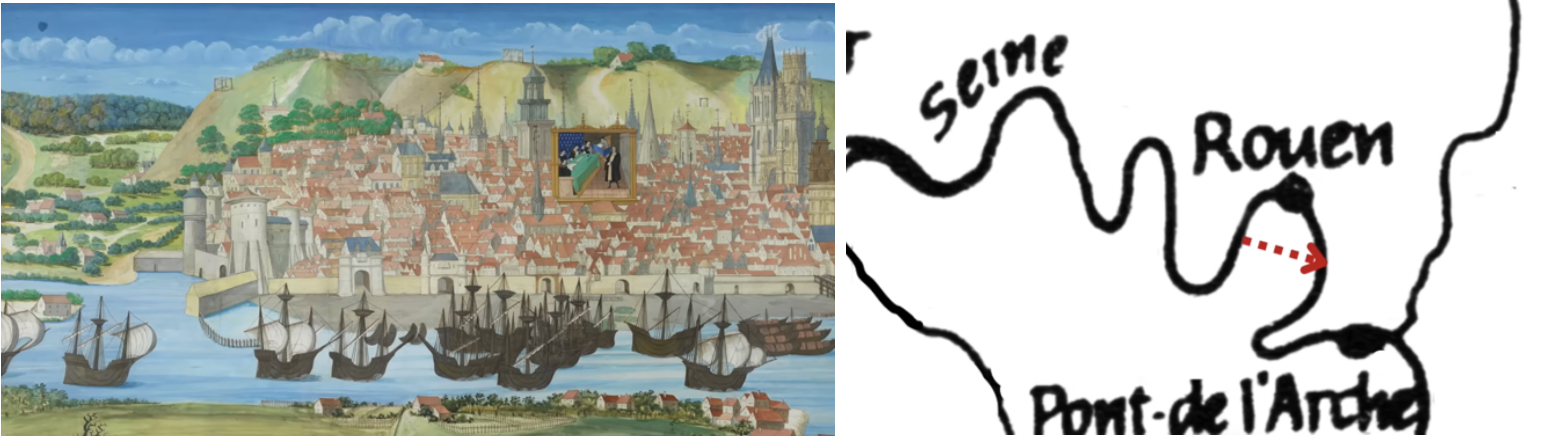
Henry V then starved Rouen into surrender through starvation, but not after many brutal killings and allowing thousands to die horribly. The city finally surrendered in 1419. The result so feared the French, that cities surrendered even without an English army threatening them.
Henry V and Harfleur
“Once more unto the breach…”
Where: Harfleur (near Le Havre) was once the primary city at the mouth of the Seine.
When: 1415
Who & Relation: Henry V is the great-grandson of Edward III, he’s a single man proving himself as a king.
What: A horrific, threatening siege with clever engineering on offense and defense.
Pop Reference: YouTube and books
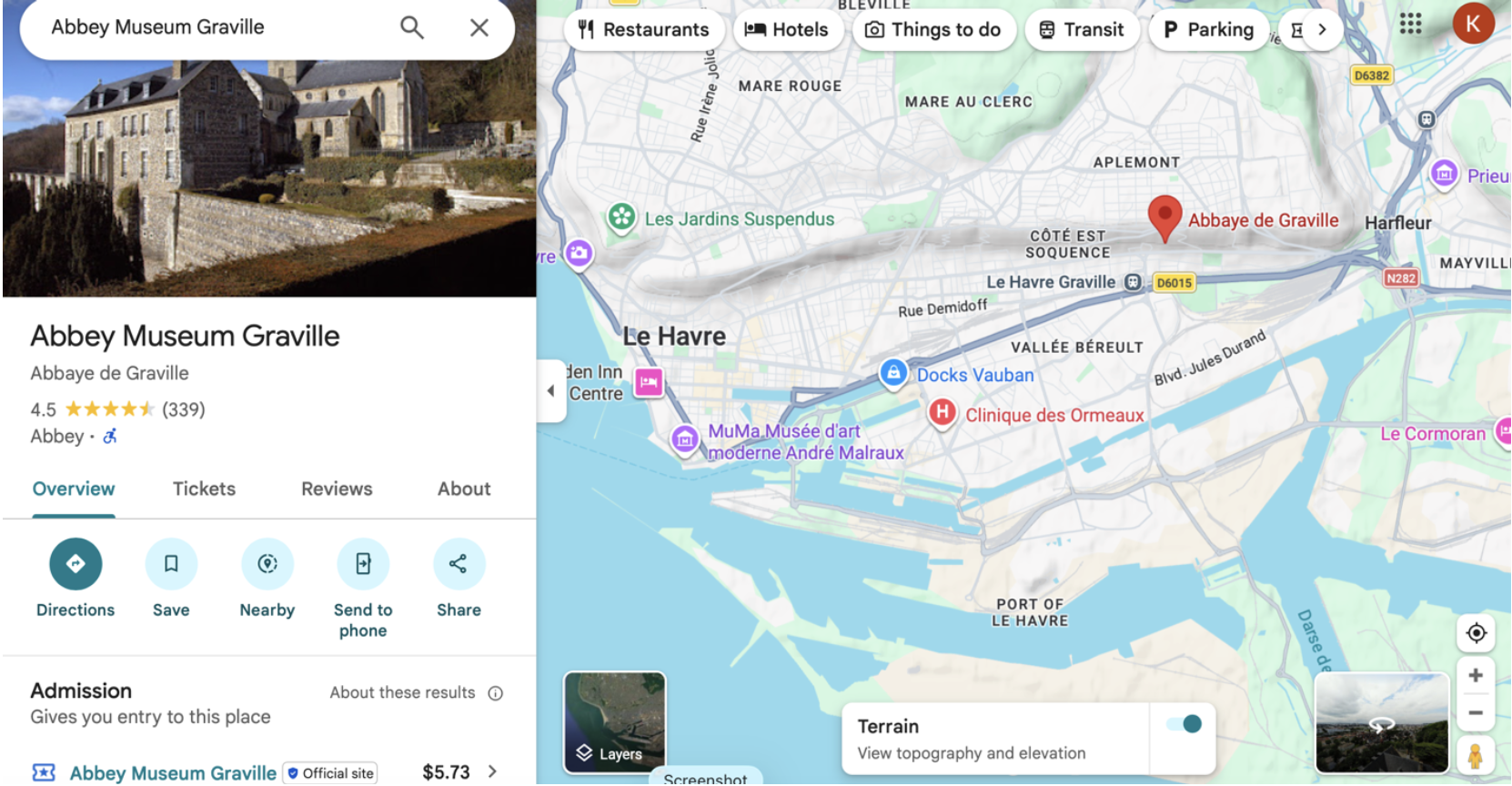
Our cruise stops in Le Havre and there are excursions to Honfleur on the west side of the Seine. However, Le Havre is on the east side and nearby is another interesting story to share. In fact, if a military campaign is attempted in Normandy, it’s a huge decision about whether to land on the east side or west side of the Seine.
At the start of the Hundred Years War, Edward III decided to make a surprise landing to the west (similar to the WWII D-Day situation), where the beaches were sandy and a few conquests could establish a strong base. But Edward had a heck of a time eventually moving east because the Seine is a difficult wet crossing. When Edward’s great-grandson Henry V started his campaign in 1415, he decided to avoid crossing the Seine and instead came to the rocky hard-to-land-upon beaches off the fortified city and harbor of Harfleur. After a tough siege, he succeeded and when his army tried to make it farther eastward to Calais, he also had a hard wet crossing of the Somme estuary.
Henry’s tired and hungry army was finally caught by a fresh, much larger, and ready-to-fight French army that want revenge for the Edward III’s victory at the Battle of Crécy. That’s a lot of years to wait, yet once again the English were miraculously victorious. We Anglophiles rarely hear about the Battle of Castillon that effectively ended the Hundred Years because the French it won decisively in 1453.
But back to Henry V at Harfleur, it will be very interesting to imagine the lay of the land, the harbor and the offensive and defensive tactics that came to play. There are variations on how to lay siege (e.g. destroy versus starve). Harfleur was a starve action.
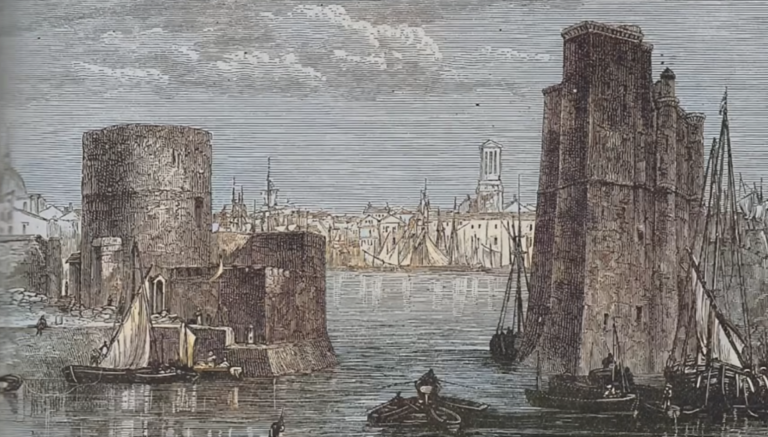
Harfleur was strategically vital for controlling access inland and a gateway toward Rouen and Paris. Henry V needed a secure foothold before advancing deeper into France. The English crossed the Channel in August 1415 with 10,000–12,000 troops, a mix of men-at-arms and longbowmen. He quickly surrounded Harfleur and began siege operations.
Harfleur wasn’t taken by a single dramatic assault—it fell through systematic pressure using multiple siege techniques. Earlier Medieval sieges (e.g. 1200s) relied on starvation, blockage and catapults. Against Harfleur, Henry used a variety of techniques and new technologies, including artillery bombardment (early cannon use), continuous pressure and assaults, and mining and undermining walls (specialists dug tunnels under the walls, propped them up with wooden supports, then burned the supports resulting in sudden collapse).
Disease was the real enemy. Dysentery (often called the “bloody flux”) spread rapidly in crowded camps and poor sanitation worsened it. Hundreds, possibly thousands, fell sick and Henry lost a huge portion of his army before even fighting a major battle.
After five weeks, in September 1415 the defenders surrendered because starvation and bombardment had weakened them physically and mentally. The town capitulated under negotiated terms. Henry expelled many inhabitants and replaced them with English settlers. He left a garrison to hold the port and returned to England from Calais to celebrate (although he had to endure and survive the Battle of Agincourt first) – which also added to his prestige and wealth at home. Harfleur became a permanent English base (for a time).
Henry wasn’t just a battlefield commander. He understood logistics and engineering, used multiple coordinated tactics and knew when to stop and accept surrender. His strength was discipline and system—not reckless assault. During the siege, he habited the Abbaye de Graville and directed the activities from there.